Introduction
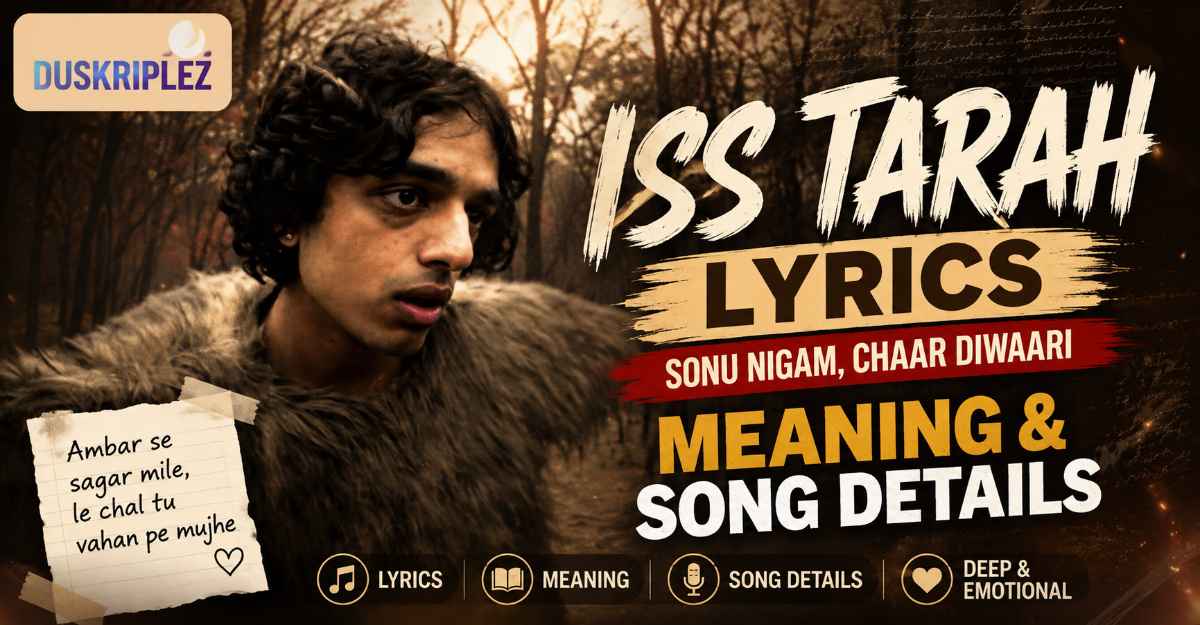
If you are searching for the complete Iss Tarah Lyrics, meaningful English translation, and detailed song insights, duskriplez.com has everything you need in one place. Iss Tarah Lyrics by Sonu Nigam and Chaar Diwaari beautifully blend heartfelt emotions, poetic storytelling, and soulful melodies that leave a lasting impression on listeners.
Released as part of the Parvana EP, the song explores themes of love, longing, devotion, and emotional surrender while drawing inspiration from India’s rich poetic traditions. On duskriplez.com, this guide covers the Iss Tarah Lyrics, the song’s deeper meaning, complete credits, English translation, and interesting facts to help fans better understand the artistic vision behind this unforgettable musical collaboration.
Song Credits
| Detail | Information |
| Song Title | Iss Tarah |
| Album / EP | Parvana EP |
| Singers | Chaar Diwaari, Sonu Nigam |
| Music Composer | Chaar Diwaari (Garv Taneja) |
| Lyricist | Chaar Diwaari (Garv Taneja) |
| Producer | Chaar Diwaari |
| Mixing Engineer | Hanish Taneja |
| Sarangi | Taran Sherpuri |
| Bansuri | Abhishek Kumar |
| Music Video Director | Chaar Diwaari, Maan Baruah |
| Music Label | Universal Music India / Def Jam India |
| Release Date | February 26, 2026 |
| Language | Hindi |
| Genre | Indie Pop / Soul |
Detail About Iss Tarah Lyrics

A Song Built Around the Fear of Finality
The opening lines of Iss Tarah do something that very few contemporary Hindi songs dare to do. Rather than beginning with a straightforward expression of love or attraction, they begin with a place, a threshold, a point where the sky meets the ocean. Ambar se sagar mile, le chal tu vahan pe mujhe is an invitation to be taken to a boundary where two vast things become one, and that image immediately tells the listener that this is a song about dissolution, about two incomplete people seeking to become whole.
The repeated refrain Iss tarah aa, phir hum mil na paayein is the emotional engine of the track. It translates roughly as Come to me in such a way that we may never be apart again. This line carries a gentle but unmistakable urgency, a fear that time is slipping by and that each meeting might be the last. The evening fading, the deewana searching, these images reinforce that sense of a love existing against a ticking clock.
Chaar Diwaari as a lyricist chooses imagery that is both classical and conversational. He does not reach for abstract philosophy alone. He grounds his ideas in half-days, half-nights, a cup of wine mixed with the sky, the sounds of payal jingling at feet, and the figure of Meera dancing before her Mohan. These are references that any listener with even a passing familiarity with Indian devotional tradition will recognize immediately, and their presence in a modern indie pop track is what gives the song its unique depth.
The Meera and Radha Symbolism
One of the most striking sections of Iss Tarah is the passage where the narrator invokes Meera, the 16th-century poet-saint whose entire life was an act of devotion to Lord Krishna, whom she called Mohan. Meera danced, sang, and surrendered everything to her divine love, refusing the earthly world and its expectations. By saying Naachun main Meera banke, lajjaati Radha si main, the narrator is not just drawing a poetic comparison. She is saying that her love has reached the level of spiritual surrender.
This is bhakti poetry dressed in modern clothing, and it represents one of the more moving uses of classical reference in recent Hindi independent music. The lines that follow, asking Mohan to hold her in his arms now because no one knows what tomorrow holds, bring that devotion back to earth with a quiet desperation that is deeply human and instantly relatable.
The Wanderer’s Verse
The closing section of the song shifts in tone and perspective, giving voice to someone who has been walking with blistered feet, lips carrying a name that cannot be spoken aloud, talking to himself in the silence. This image of a lonely wanderer is one of the oldest in Urdu and Hindi poetry, and its placement here works as a counterpoint to the more hopeful, devotional sections earlier in the song.
The bhanvra, or bee, whispers to the narrator that he has become like a mad moth. The bee’s observation is not cruel, it is simply a recognition of what extreme longing does to a person. And the final question, Aisa kya tha mujhmein ke tujhko main na dikha, which asks what was lacking in him that made him invisible to the one he loved, lands with a quiet devastation that stays with the listener long after the song ends.
The Production and Its Classical Touches
Chaar Diwaari’s production choices are as meaningful as his words. The Sarangi, traditionally associated with expressions of deep emotion and even grief in classical Indian music, runs through the track like a thread connecting it to centuries of musical heritage. The Bansuri, the flute famously linked to Lord Krishna himself, adds another layer of devotional imagery that reinforces the Meera and Mohan references in the lyrics. These are not decorative choices. They are structural ones, designed to make the listener feel the weight of what is being said.
Sonu Nigam’s voice, known for its extraordinary range and ability to convey nuance, is perfectly suited to material like this. He does not oversing or reach for dramatic flourishes. Instead, he allows the emotion in the melody to do the work, which is exactly what a song this restrained and interior demands. The collaboration between his vocal instinct and Chaar Diwaari’s compositional vision is one of the most satisfying things about the track.
Iss Tarah Lyrics
Lyrics:
Ambar se sagar mile
Le chal tu vahan pe mujhe
English Translation: Where the sky meets the ocean, Take me to that place with you.
Lyrics:
Iss tarah aa
Phir hum mil na paayein
Aa ja, shaam dhalti jaaye
Jana, dhundhe tujhe deewana
English Translation: Come to me in such a way That we may never be separated again. Come, for the evening is fading away, My love, a lovesick soul is searching for you.
Lyrics:
Iss tarah aa
Phir hum mil na paayein
Aa ja, shaam dhalti jaaye
Jana, dhundhe tujhe deewana
English Translation: Come to me in such a way That we may never be separated again. Come, for the evening is fading away, My love, a lovesick soul is searching for you.
Lyrics:
Aadha dil aadhi rooh
Main aadha hoon
Aadhi tu aise hon
Hum aadhe kyu?
Kya kuch aisa karein
Hum samay ke pare
Mil jaayein
Hum pighal jaayein
English Translation: Half a heart, half a soul, I am only half. You too are only half, so why must we remain incomplete? What if we could do something That places us beyond the reach of time? Let us meet, Let us melt into each other.
Lyrics:
Aadha din aadhi raat
Aakash se tod loon
Ghol doon ek pyaale mein
Pyala main bhi piyoon
Pyala tu bhi piye
Mil jaaye
Waqt pighal jaaye
English Translation: Half a day, half a night, Let me pull them down from the sky. Let me dissolve them together in a single cup. Let me drink from that cup, Let you drink from it too. May we finally meet, May time itself melt away.
Lyrics:
Aisi jahan hala mile
Le chal tu vahan pe mujhe
English Translation: Where such a moment of bliss can be found, Take me there with you.
Lyrics:
Iss tarah aa
Phir hum mil na paayein
Aa ja, shaam dhalti jaaye
Jana, dhundhe tujhe deewana
English Translation: Come to me in such a way That we may never be separated again. Come, for the evening is fading away, My love, a lovesick soul is searching for you.
Lyrics:
Iss tarah aa
Phir hum mil na paayein
Aa ja, shaam dhalti jaaye
Jana, dhundhe tujhe deewana
English Translation: Come to me in such a way That we may never be separated again. Come, for the evening is fading away, My love, a lovesick soul is searching for you.
Lyrics:
Kya maine koi maangi dua
Sajdaa kya koi kiya
Kisi rishi ki kya lagi kripa
Jo maine tujhe dekha
English Translation: Did I make some special prayer? Did I bow before someone in devotion? Did the grace of some sage fall upon me? That I was blessed with the sight of you.
Lyrics:
Pairon mein payal jhanke
Naachun main meera banke
Lajjaati radha si main
Gar mere mohan hass dein
English Translation: Anklets ring at my feet, I dance like the devotee Meera. I become shy like Radha herself, If my Mohan smiles at me.
Lyrics:
Mohan ko
Pyaar mujhse agar ho
Baahon mein abhi bhar lo
Kal kya ho kisne jana?
English Translation: If Mohan Truly loves me, Then hold me in your arms right now. Who knows what tomorrow may bring?
Lyrics:
Iss tarah aa
Phir hum mil na paayein
Aa ja
shaam dhalti jaaye
Jana
dhundhe tujhe deewana
English Translation: Come to me in such a way That we may never be separated again. Come, For the evening is fading away, My love, A lovesick soul is searching for you.
Lyrics:
Ghar se awara main
Paanv mein chhaale bhar ke
Chalta raha
Hothon pe tera naam
Sil kar main baatein khud se
Karta raha, karta raha
English Translation: Homeless and wandering, With blisters filling my feet, I kept walking. Your name forever on my lips, Sealing away my words, talking only to myself, I kept going, I kept going.
Lyrics:
Bhavron ne mujhse kaha
Pagal patanga hua
Lagta hai unko nahi
Tu dikh raha
English Translation: The bees whispered to me, That a mad moth has appeared. It seems to them That you are not visible to him.
Lyrics:
Ab main ye
Poochta hoon tujhse ke
Aisa kya tha mujhmein ke
Tujhko main na dikha
English Translation: Now I ask you this, What was it about me That made me so invisible to you?
Read More: Dooron Dooron Lyrics by Paresh Pahuja Meaning and Details
Read Also: Swami Song Lyrics by Avdhoot Gandhi x Brahmaa
Frequently Asked Questions
Who is the singer of the song Iss Tarah?
Iss Tarah is sung by Sonu Nigam and Chaar Diwaari. Sonu Nigam is one of the most celebrated playback singers in Hindi film music, widely recognized for his versatility, vocal range, and emotional depth. Chaar Diwaari is the independent music artist and creative force behind the EP Parvana, and his voice brings a raw, introspective quality to the track that balances beautifully with Sonu Nigam’s polished delivery.
Who wrote the lyrics of the song Iss Tarah?
The lyrics of Iss Tarah were written by Chaar Diwaari, also known as Garv Taneja. He is the sole creative force behind the songwriting on this track, blending Urdu poetic tradition, references to bhakti literature, and deeply personal emotional expression into a cohesive and moving piece of writing.
Who composed the music for Iss Tarah?
The music for Iss Tarah was composed by Chaar Diwaari (Garv Taneja). He also produced and arranged the entire track, making it a fully self-realized creative project. The composition features traditional Indian instruments including the Sarangi and Bansuri, woven into a modern atmospheric soundscape that gives the song its distinctive emotional texture.
Which music label released the song Iss Tarah?
Iss Tarah was released under Universal Music India and is associated with Def Jam India. It is part of Chaar Diwaari’s EP Parvana, which was released on February 26, 2026.
Who directed the music video for Iss Tarah?
The music video for Iss Tarah was directed by Chaar Diwaari and Maan Baruah. The video features Chaar Diwaari and complements the song’s themes of longing, wandering, and devotion through its visual storytelling.
What is the meaning of the title Iss Tarah?
Iss Tarah translates directly to In This Way or Like This in English. Within the context of the song, the phrase is used as part of a plea, Come to me in this way, so that we may never be separated again. It captures the idea of a perfect, irreversible union between two souls, a longing not just for a meeting but for a merging so complete that separation becomes impossible. The title is deceptively simple, yet it carries the full emotional weight of the song within its two words.
What does the Parvana EP represent?
The word Parvana means a moth in Hindi and Urdu, and in classical Persian and Urdu poetry, the moth drawn to a flame is one of the most enduring metaphors for unrequited love and spiritual devotion. As the title of Chaar Diwaari’s EP, it frames the entire collection, including Iss Tarah, as an exploration of love that is consuming, self-sacrificing, and impossible to resist. Iss Tarah is the centerpiece of this EP and the track that most fully expresses the parvana metaphor through its imagery, its references to Meera and devotion, and its portrait of a wanderer who cannot stop searching even when hope is uncertain.
Conclusion
Iss Tarah is a song that rewards careful listening. On the surface, it is a beautiful, soulful track built around a simple plea for togetherness. Beneath that surface, it is a carefully layered piece of writing that draws on Meera’s devotion to Krishna, the imagery of classical Urdu poetry, and the universal human experience of loving someone so deeply that half your life feels absent without them.
Chaar Diwaari’s decision to take on every creative responsibility, from writing and composing to producing and directing, gives the track a rare unity of vision. Every element, the Sarangi’s melancholy pull, the Bansuri’s devotional echo, the restrained atmospheric production, and the words themselves, works toward a single emotional truth.
And then there is Sonu Nigam, whose voice has been a constant in Hindi music for decades, lending this track the kind of warmth and credibility that only comes from a lifetime spent singing about the full range of human feeling. His presence on Iss Tarah is not a celebrity feature. It is a genuine artistic contribution, and the song is richer for it.
Whether you found this track on a late-night playlist, discovered it through a reels scroll, or stumbled across the Parvana EP by chance, Iss Tarah is the kind of song that lingers. It asks the oldest question in love, what if we had more time, and leaves the answer, as the best songs always do, entirely up to you.

Humair is the founder of PeakMagzine.com and a seasoned digital strategist with over 15 years of SEO experience. He specializes in creating high-quality, optimized content that drives organic traffic, improves search rankings, and helps brands grow their online presence effectively.